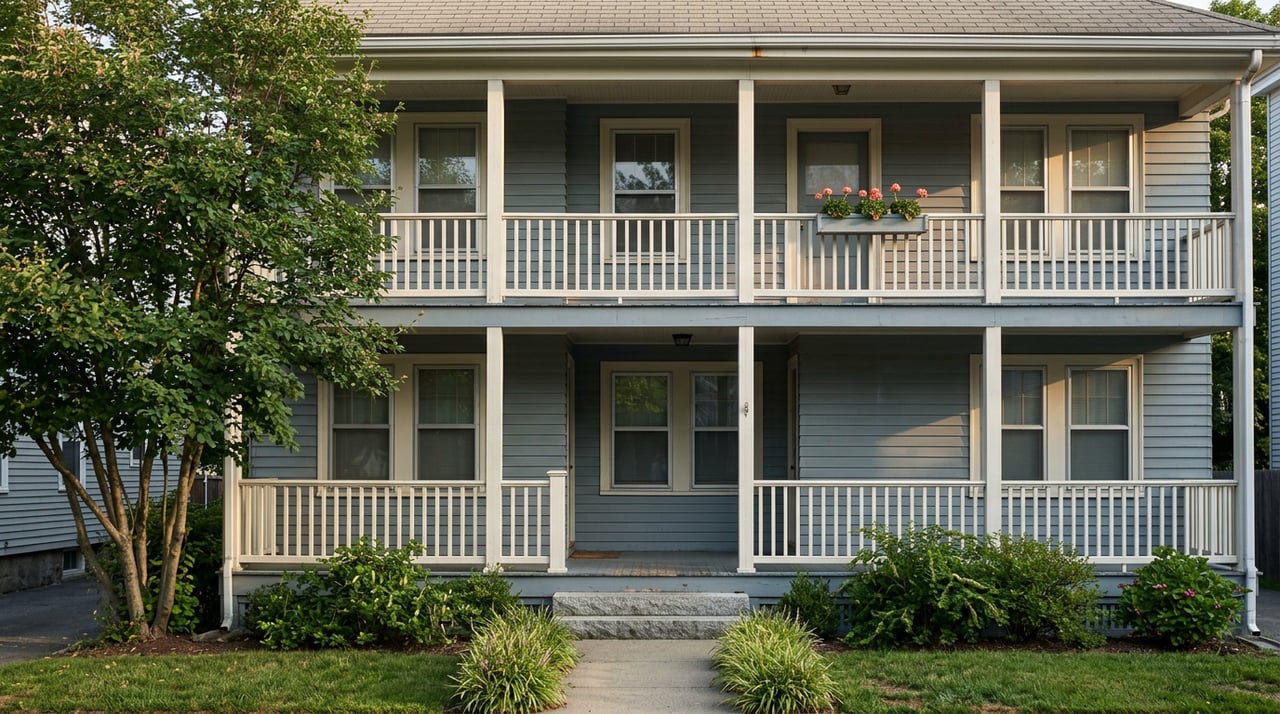
What to Watch in the Lawrence MA Multi-Family Market in 2026
August 20, 2026
August 20, 2026
If you have been tracking Lawrence on a portal alert, you saw it too. The average sale price jumped nearly 14 percent in a single month this summer. If you are shopping for a two or three family and you saw that number, your first instinct was probably to assume the window is closing and you need to move fast on your next offer.
Don't do that yet. The same month that price jumped, the number of homes that actually sold in Lawrence fell. Sharply. That combination, price up while volume down, is not a sign of a market getting stronger. It is a sign of a market getting thinner, and for multi-family buyers specifically, a thin market changes what the average is even measuring.
Here is what the citywide data showed for June 2026 compared to the months around it.
| Metric | June 2026 | Change |
|---|---|---|
| Average sale price | $407,000 | Up about 14% from May 2026 |
| Average sale price, year over year | $407,000 | Up about 12% from June 2025 |
| Homes sold | Declined | Down about 8% from May 2026, down about 12% from June 2025 |
| Year-to-date sales | Declined | Down close to 15% for the year |
| New listings, year to date | Declined | Down about 10% |
| Average price per square foot | $195 | June 2026 |
Read those two rows together. Price went up. Volume went down, both month over month and year over year, and new listings kept shrinking too. When fewer homes trade, each individual sale carries more weight in the average. One expensive closing can drag the number up even if nothing about affordability actually changed for the typical buyer.
This matters more in Lawrence than it would in a town where every sale is a similar single-family colonial. Lawrence's housing stock is genuinely mixed. A one-family ranch, a mid-size two-family, and a nine-unit apartment building can all close in the same month, and each one pulls the average in a different direction depending on how big the sale price is relative to the rest.
As of January 2026, multi-family listings in Lawrence ranged from roughly $579,900 up to $3.2 million, with multi-family homes averaging about 22 days on market before selling. That spread is enormous. A 2-unit starter property and a large apartment building sit in the same category, and both count toward the same "average sale price" line that portals report citywide.
When the overall pool of transactions shrinks, as it did in June, the mix of what actually closes matters more than it does in a high-volume month. If a handful of larger multi-family sales close while smaller starter-home sales stall, the average price rises even though the market a typical first-time or entry-level multi-family buyer is competing in has not necessarily gotten more expensive. The number goes up. The experience of shopping for a two-family under $700,000 may not have changed at all.
This is the trap. An investor who sees "average price up 14 percent" and assumes every property just got 14 percent more expensive is reading a number that was built by a handful of closings, not by the whole market moving together. The right response to that headline is not to raise your offer. It is to ask what actually sold, and whether your target property type behaved the same way.
If the average price is the least stable number to anchor a multi-family offer to right now, what should you use instead? Two inputs that don't swing with a thin month of closings, because they are structural rather than transactional.
None of these numbers tell you what to offer on a specific building. What they do is give you a way to test whether a listing price makes sense on its own terms, independent of whatever the citywide average did last month.
Lawrence's multi-family market does not exist in a vacuum. The city has spent the better part of a decade turning its old textile mills into housing, and that pattern is worth watching if you are trying to figure out where rents and comparable sales go from here.
WinnCompanies opened Stone Mill Lofts in September 2024, an adaptive reuse of what the developer describes as the oldest mill building in the city, delivering 86 units, most reserved for households earning up to 60 percent of area median income and a smaller share at market rate. It was framed as one of the first all-electric apartment communities in Massachusetts.
Before that, Reed Realty's Pac 10 Lofts converted a portion of the former Pacific Mills complex into 180 units, and MassHousing closed $26.9 million in financing for Trinity Financial's redevelopment of the historic Marriner Mill building at 608 Broadway into 87 planned apartment homes, part of the 34-acre Arlington Mills Smart Growth Overlay District.
None of these are single-family or two-family comps you would use directly in an appraisal. What they signal is sustained institutional confidence in Lawrence as a place where rental demand justifies large capital investment, project after project, over multiple years. For a small multi-family investor, that is a useful backdrop. It suggests the rental base underneath your two or three family is not dependent on one company or one moment, it is being reinforced by outside capital that keeps betting on the same city.
Should I wait for the average price to come back down before buying? Averages built on a thin, shrinking number of monthly sales can bounce in either direction the next time volume shifts. Waiting for a single monthly number to "correct" is less useful than underwriting the specific property in front of you against rent and tax fundamentals that hold steady.
Does more rental supply from mill conversions threaten my rents? Large mixed-income developments serve a different renter profile than most owner-occupied two and three families, since a majority of those mill units are income-restricted. They add to the overall housing supply story, but they are not a direct substitute for market-rate units in an owner-occupied multi-family.
How do I actually compare Lawrence to a nearby town like Methuen or Andover? Start with the property tax rate and rent per unit, since those don't move with a single month's transaction count, then layer in the specific building's condition and unit mix. That comparison holds up better than lining up two portal-reported averages side by side.
If you are weighing a two, three, or four family purchase in Lawrence and want to run the actual numbers on a specific property, tax rate, financing structure, and all, that is exactly the kind of work I do every day. Juan Concepcion combines local transaction experience with a finance and tax background built through JC Consultants, so you are underwriting with real numbers instead of a headline average. Schedule a consultation and we will build the math together.
Stay up to date on the latest real estate trends.


Whether you’re buying or selling, I’m here to guide you through every step of the process. With personalized service and a deep understanding of the market, I’ll ensure your real estate experience is smooth and successful.